


CALL US NOW!
+65 9009 7510
CALL US NOW!
+65 9009 7510
Swimming Pool Contractor Singapore: Costs and Services Guide 2026
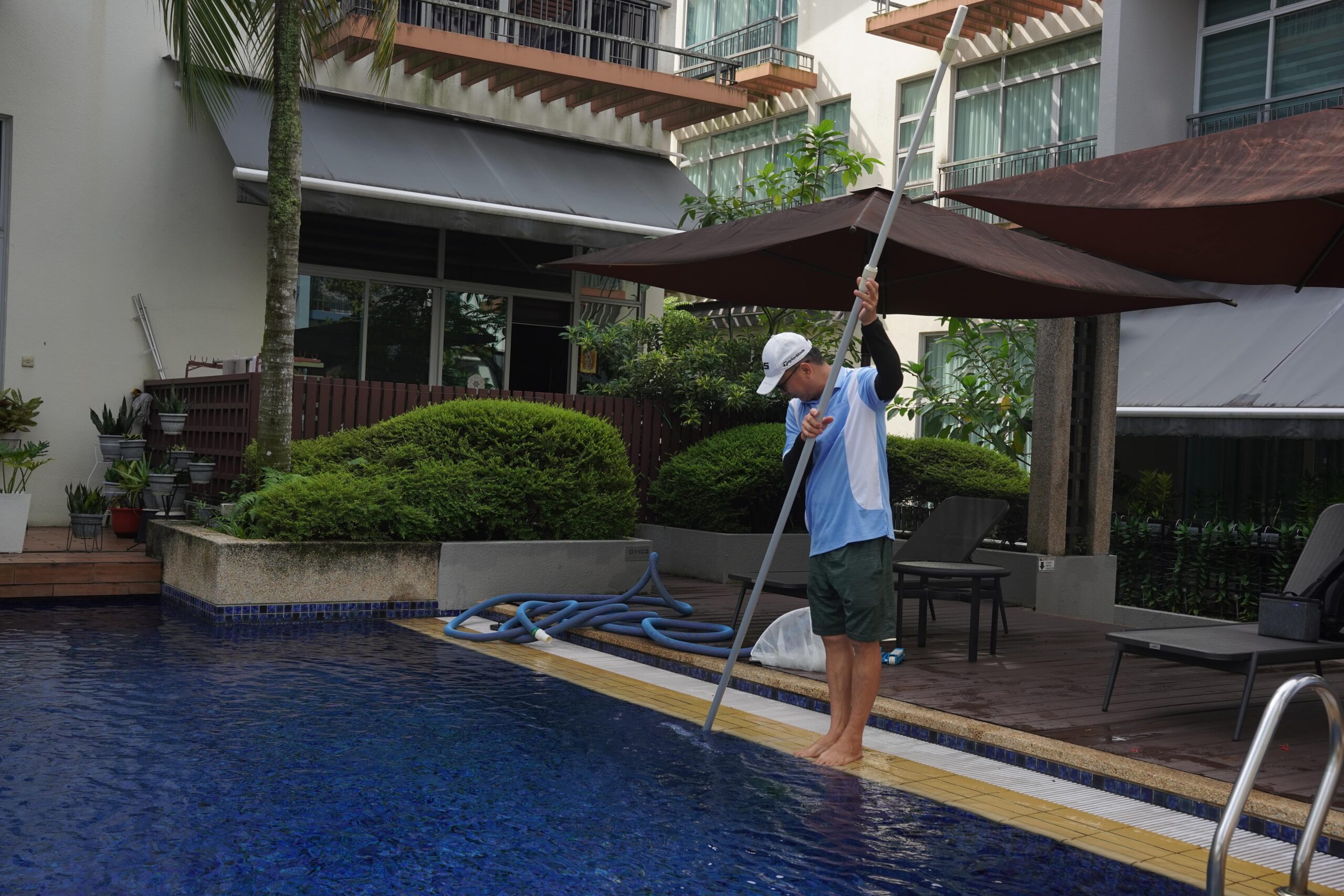
Choosing a swimming pool contractor in Singapore involves more than comparing tiles, water colour and the lowest quotation. A reliable contractor should understand the pool as one connected system involving the structure, waterproofing, plumbing, circulation, filtration, pumps, electrical equipment and water chemistry.
For a new pool, the contractor should explain design constraints, approvals, structural work, equipment specifications, finishes, construction stages and long-term operating costs. For an existing pool, the contractor should inspect the complete system before deciding whether the problem requires routine maintenance, targeted repair, resurfacing or a larger renovation.
Indicative costs vary widely. KCN Pool Services currently publishes monthly maintenance rates of approximately S$150 to S$350 for landed-home pools, while standard pump repairs generally range from S$120 to S$350. Partial fibreglass coating for small damaged areas is listed at approximately S$400 to S$900. New-pool construction can range from tens of thousands of dollars for a compact pool to more than S$150,000 for premium, rooftop or infinity designs. Every figure should be confirmed through an inspection and written quotation because access, ground conditions, finishes, equipment and existing damage can change the final scope significantly.
KCN Pool Services supports landed homeowners, condominium managers and commercial properties with swimming pool cleaning, scheduled maintenance, pump repair and replacement, filter servicing, green-pool recovery, plumbing and equipment work, retiling and fibreglass coating. Its published materials also cover new-pool construction and remodelling, although customers should confirm the exact construction scope, consultants and subcontractors included in a project proposal.
Key Takeaways
Swimming pool services fall into four different categories: construction, maintenance, repair and restoration. Construction creates a new pool or substantially changes an existing one. Maintenance is recurring preventive care. Repair addresses a particular fault in the pump, filter, plumbing or other equipment. Restoration improves an ageing pool through work such as green-pool recovery, retiling, resurfacing or fibreglass coating.
The lowest quotation is not necessarily the lowest total cost. A useful proposal should explain the diagnosis, work scope, equipment brands, materials, labour, exclusions, estimated duration, warranty terms and circumstances that could change the price.
Most landed-home pools benefit from regular weekly attention, although the exact schedule should reflect pool size, exposure, equipment and usage. KCN recommends weekly service for most landed pools and typically recommends more frequent visits for shared facilities. This is a service recommendation rather than a universal legal frequency for every property.
Private landed-home pools and shared non-residential pools do not have identical regulatory responsibilities. NEA regulates licensable aquatic facilities with recirculation systems at non-residential premises. These facilities require licensing, accredited laboratory testing, result submission and ongoing cleanliness. Their licensees must also arrange daily on-site testing for pH and residual disinfectant.
KCN’s service pages contain specific claims about pricing, inspection fees, safety credentials and workmanship support. Owners and managing agents should confirm that these details remain current and should verify applicable business registrations or bizSAFE recognition before awarding work.
How This Guide Was Developed
This guide combines KCN Pool Services’ published service scope and current pricing with official Singapore guidance from the National Environment Agency, PUB and the Building and Construction Authority.
KCN’s published rates are used where the company provides a clear service range. These figures are examples of KCN’s current pricing rather than guaranteed market averages. The final quotation may differ after the pool is inspected.
Official Singapore sources are used to explain the distinction between private residential pools and regulated aquatic facilities, daily testing responsibilities, water-efficiency practices and possible approval considerations for building work.
KCN has a commercial interest in providing the services discussed in this guide. Property owners should compare relevant experience, scope, pricing, registrations, warranty terms and project suitability before choosing any swimming pool contractor.
What Does a Swimming Pool Contractor in Singapore Do?
A swimming pool contractor may design and build new pools, maintain existing facilities, diagnose faults, repair equipment and restore ageing surfaces. The exact capabilities vary between companies, so owners should not assume that every cleaning contractor also handles structural construction or that every builder provides dependable long-term maintenance.
Routine pool servicing normally focuses on water cleanliness, chemistry and basic equipment condition. A service visit may involve skimming, wall and floor brushing, vacuuming, checking water readings, adjusting chemicals, emptying baskets and inspecting pumps, strainers and filters for visible warning signs. KCN states that its cleaning service includes water testing and balancing together with basic system checks.
Repair work begins when a particular part of the system is not working correctly. Weak return flow, air in the pump basket, unusual noise, water around the pump, high filter pressure or repeated tripping may indicate a mechanical, hydraulic or electrical problem.
Restoration work addresses pools that have deteriorated beyond routine cleaning. This can include algae recovery, grout repair, tile replacement, full retiling, crack repair, resurfacing and fibreglass coating.
New-pool construction involves a much broader scope. Depending on the project, this may include concept design, excavation, structural engineering, reinforced concrete, waterproofing, plumbing, electrical systems, pumps, filters, finishes, deck works, testing and commissioning.
The contractor should clearly identify which work is completed by its own employees, which work is subcontracted and which professional consultants are required.
What Is the Difference Between Pool Maintenance, Repair, Restoration and Construction?
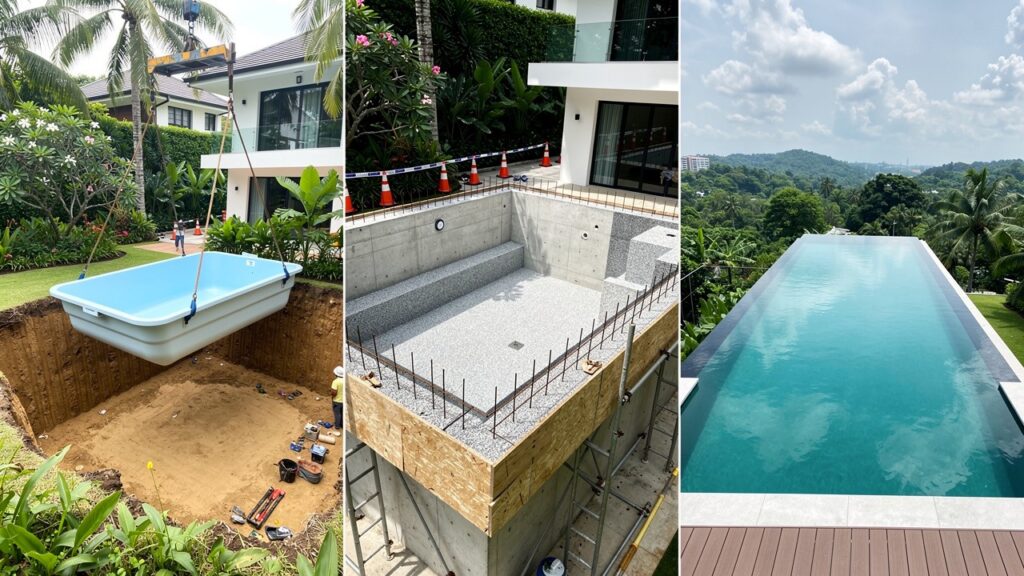
Pool maintenance is planned preventive work intended to keep the water and equipment operating normally. It should identify small issues before they become breakdowns, but it does not automatically include replacement parts or major corrective work.
Pool repair focuses on a specific fault. A pump repair may involve replacing a seal, bearing, gasket or another component. A plumbing repair may address a leaking joint or valve. A filter repair may involve its valve, internal components or filtration media.
Pool restoration addresses wider deterioration. A neglected green pool may require a separate chemical and cleaning programme. An ageing surface may need retiling or fibreglass coating. A pool losing water may require testing before surface or pipe repairs are selected.
Pool construction creates a new pool or substantially changes an existing one. It carries different design, structural, planning, cost and project-management responsibilities.
Understanding these distinctions helps an owner compare the correct service. A maintenance quotation should not be compared directly with an emergency repair, and a small coating repair should not be compared with full resurfacing.
How Much Does a New Swimming Pool Cost in Singapore?
New-pool construction costs depend heavily on the type, size, depth, structure, ground conditions, access, finishes, equipment and required professional work.
KCN’s current installation guide uses an indicative starting range of approximately S$20,000 to S$30,000 for a compact fibreglass plunge pool. It places a standard concrete lap or family pool at approximately S$50,000 to S$100,000, while premium concrete pools with full tiling, integrated spas or smart controls may range from S$100,000 to more than S$200,000. Custom infinity or rooftop projects may exceed S$150,000. These figures are planning bands from KCN’s own guide and should not be treated as fixed quotations or independently verified industry averages.
A simple pool on an accessible, level site may cost considerably less than a project requiring restricted excavation, piling, retaining work or structural strengthening. Rooftop and elevated pools usually require more complex engineering, waterproofing, lifting access and risk management.
Equipment specifications also affect both the construction price and the long-term operating budget. A quotation should identify the proposed pump, filtration system, chlorination method, lights, controls and other major components by brand and model where possible.
Finishes can change the budget substantially. Standard tiles, glass mosaics, specialist coatings, natural stone, deck materials and integrated water features have different material and installation costs.
The contractor should also explain whether professional fees, authority submissions, soil investigation, structural engineering, disposal, reinstatement, landscaping and post-completion maintenance are included.

Do Swimming Pools Require Approval in Singapore?
Some private-property building works require building or structural plans to be submitted to BCA, while certain minor works may be exempt. The appropriate treatment depends on the type and extent of work, so owners should ask a Qualified Person to confirm the requirements rather than relying solely on a contractor’s verbal assurance.
BCA’s guidance for landed properties also distinguishes between raised and sunken pools. Its homeowner guide states that raised swimming pools should maintain a setback from the common boundary, while excavation for a sunken pool can create ground-movement risks affecting neighbouring properties.
The contractor should explain who will assess planning and building-control requirements, who will prepare drawings, whether a Professional Engineer is needed and which submission or inspection costs are included.
Owners should avoid accepting a vague statement that “all approvals are included” without seeing exactly which approvals are relevant and who is professionally responsible for them.
How Much Does Swimming Pool Maintenance Cost in Singapore?
KCN currently publishes a monthly landed-home cleaning and maintenance range of approximately S$150 to S$350, depending on pool size. Condominium and commercial facilities receive customised quotations based on factors such as the number of pools, size and visit frequency.
The owner should confirm what the monthly fee includes. A lower quotation may cover only labour and basic cleaning, while another may include routine chemicals, water testing, robotic vacuuming, service records and simple equipment checks.
The quotation should state how often the contractor will attend, what happens when a scheduled visit falls on a public holiday and whether extra visits following storms, heavy usage or an algae outbreak are chargeable.
Repairs and significant corrective treatment are usually separate from routine maintenance. KCN’s cleaning page states that green or algae-affected pools require a separate restoration service because the chemicals and labour differ from ordinary servicing.
For condominiums and commercial properties, pricing may also reflect reporting, daily checks, larger plant rooms, balancing tanks, multiple water features, higher bather loads and restricted working hours.
How Much Does Pool Pump Repair or Replacement Cost?
KCN currently lists standard pump repair for landed-home pools at approximately S$120 to S$350, depending on the required parts and repair time. Complete pump replacement requires a customised quotation based on the selected model and installation requirements.
The company’s service scope includes inspection of pump housings, seals and impellers, checks for leakage or corrosion, pressure and flow testing, component replacement and system testing.
A lower-cost repair may be appropriate when the fault involves replaceable seals, bearings, gaskets or another limited component and the rest of the unit remains serviceable.
Replacement may make more sense when the motor is severely damaged, the housing is cracked, essential parts are unavailable or repeated repairs no longer provide reliable operation.
A contractor should compare repair and replacement honestly. The quotation should identify the faulty component, the expected useful life after repair, the proposed replacement model and whether plumbing or electrical changes are required.
KCN states that minor pump repairs may be completed during the same visit, while more complex repairs involving replacement parts can take approximately one to three days depending on availability.
How Much Does Fibreglass Coating Cost?
KCN currently lists partial fibreglass coating for small damaged areas or isolated cracks at approximately S$400 to S$900 for landed-home pools. Full-pool coating requires a customised quotation based on pool size, existing damage, preparation, number of layers and curing requirements.
The process normally includes draining the pool, preparing and cleaning the existing surface, repairing cracks or holes, applying fibreglass resin layers, adding a protective topcoat and allowing the coating to cure before the pool is refilled.
Fibreglass coating can be useful where the existing surface is stained, rough, cracked or difficult to maintain. However, it should not be treated as a universal answer for every leak.
A structural movement problem, active crack or plumbing leak may require separate repair before coating. The contractor should explain what caused the visible damage and whether the proposed coating addresses the underlying fault.
KCN’s service page states that workmanship-related coating issues are covered by a return-and-fix commitment. The written quotation should define the warranty period, exclusions and maintenance conditions clearly.
How Much Do Retiling, Plumbing and Green-Pool Restoration Cost?
Retiling, major plumbing work and green-pool recovery normally require site-specific quotations because the visible pool size alone does not reveal the required labour and materials.
Retiling costs can change according to how much of the pool must be drained and stripped, whether the substrate is sound, the type of tile selected, grout condition, waterproofing and access.
Plumbing costs depend on the location and type of leak. An accessible valve or joint can be very different from a concealed underground pipe, balancing-tank problem or embedded fitting.
Green-pool restoration depends on algae severity, debris, chemistry, circulation, filtration condition and how long the pool has been neglected. A contractor may need to treat the water, brush and vacuum repeatedly, clean the filtration system and repair the circulation fault that allowed algae to return.
Owners should be cautious of any contractor giving a fixed major-restoration price from one photograph without inspecting the water and equipment.
What Factors Change the Final Swimming Pool Quotation?
Pool size and depth affect the quantity of water, chemicals, surface materials and labour required. Larger and deeper pools generally require more time and resources.
Access can have an equally important effect. A plant room beside a landed-home driveway is easier to service than equipment in a tight basement, rooftop enclosure or restricted condominium area.
The pool’s current condition matters because visible symptoms may hide broader problems. A few missing tiles can be a local issue, or they may indicate failed grout, movement or water entering behind the finish.
Equipment age and parts availability also affect cost. Repairing a common pump with available components is different from sourcing discontinued parts for an older imported model.
For restoration work, surface preparation can form a large part of the quotation. New materials will not perform properly if the substrate is loose, contaminated or inadequately prepared.
Shared facilities may require more extensive safety planning, access control, resident communication, testing and reopening procedures. The cost of closing a condominium or commercial pool can also influence how the work is scheduled.
KCN’s Inspect–Diagnose–Quote–Restore–Maintain Approach
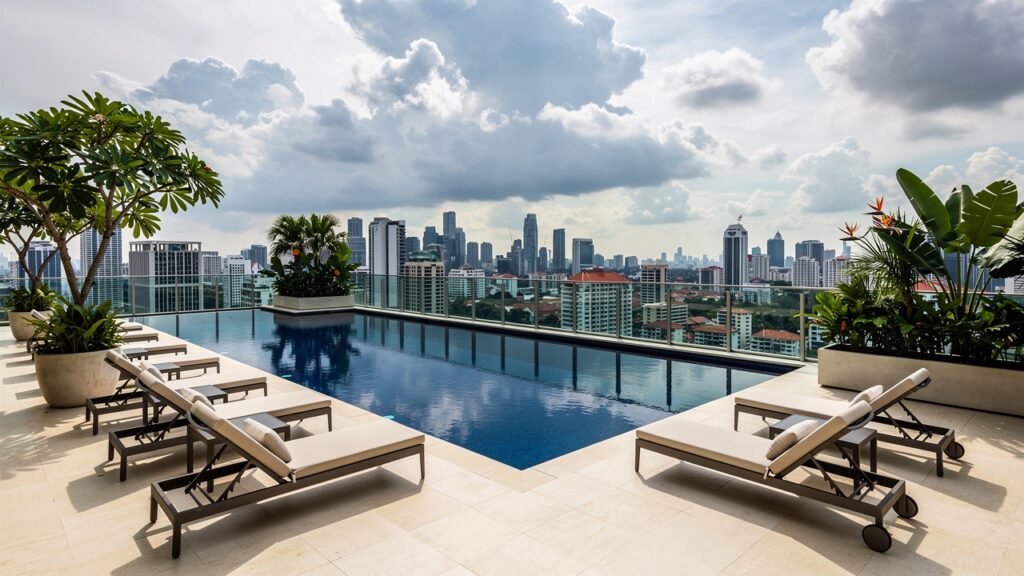
A useful swimming pool contractor should begin with inspection rather than immediately prescribing replacement.
The Inspect stage examines water condition, circulation, filtration, visible surfaces, fittings, pipes and relevant equipment. The technician should listen to the owner’s observations but also test whether the visible symptom matches the suspected cause.
The Diagnose stage identifies the likely root problem. Cloudy water may result from chemistry, contamination, filtration or circulation. A noisy pump may involve air entry, blockage, bearings, vibration or electrical components. Falling water levels may involve evaporation, plumbing, shell defects or fittings.
The Quote stage explains the recommended work, materials, replacement parts, labour, exclusions and possible variations. It should distinguish necessary work from optional improvements.
The Restore stage may involve cleaning, chemical treatment, repair, replacement, retiling or coating. The pool should be tested after the work rather than handed back immediately after installation.
The Maintain stage explains how the owner can protect the result. This may involve a regular service plan, chemical requirements, curing instructions, inspection intervals and warning signs to monitor.
This sequence helps owners compare contractors based on their reasoning rather than on sales claims alone.
What Pool Problems Need Professional Attention?
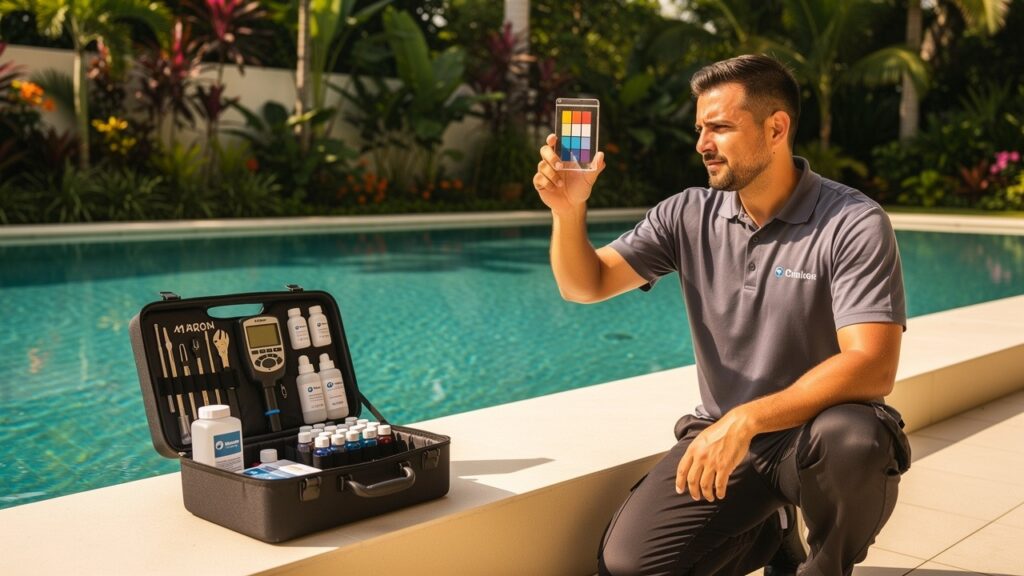
A pool should be inspected when water remains cloudy despite normal cleaning and chemical correction. Persistent cloudiness may indicate ineffective filtration, weak circulation, contamination or an imbalance that cannot be resolved by adding more chlorine alone.
Recurring green water often means the original treatment did not address the complete cause. Algae may return when circulation is weak, filtration is inadequate, chemistry is unstable or algae remains in surfaces and equipment.
A noisy pump deserves attention when the sound is new, persistent or accompanied by reduced flow, overheating, leakage or tripping. Continuing to operate a struggling pump can turn a replaceable component fault into a more expensive failure.
Air bubbles from the returns or visible air inside the pump basket can indicate air entering the suction side of the system. The cause may be simple, such as low water level or an O-ring, but it can also involve the plumbing.
An unusual fall in water level should not be dismissed automatically

Leave A Comment