


CALL US NOW!
+65 9009 7510
CALL US NOW!
+65 9009 7510
Swimming Pool Maintenance Companies Singapore: 2026 Selection Guide
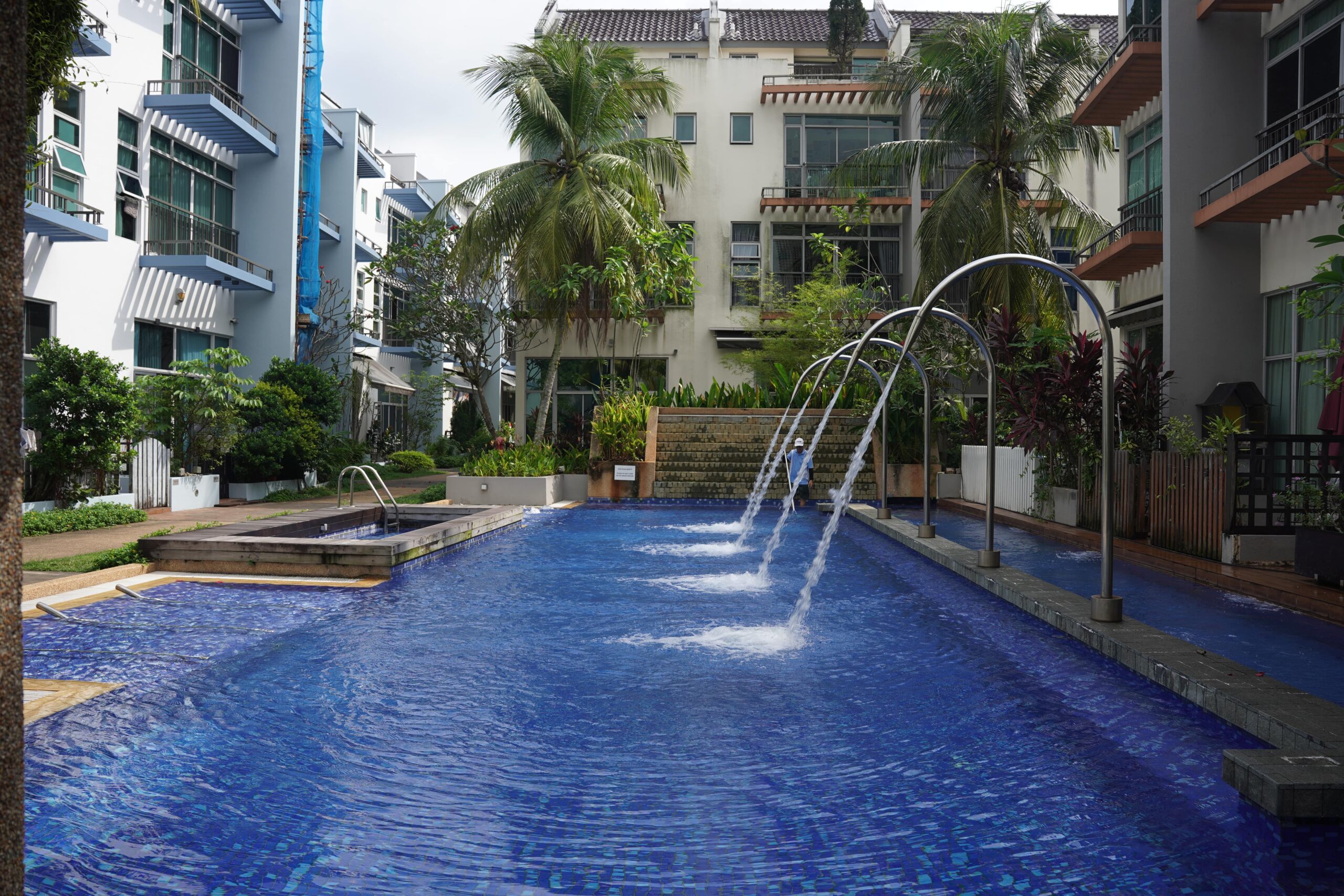
Choosing between swimming pool maintenance companies in Singapore requires more than comparing monthly fees. A suitable provider should clean the pool, test and adjust the water, inspect circulation equipment, document important readings and explain when separate repairs are genuinely required.
This matters because a pool can look clear while still having incorrect chemical levels, weak circulation, an overloaded filter or an early equipment fault. Singapore’s warm weather, frequent rainfall and year-round pool use can also change water conditions quickly.
For landed-home pools, KCN Pool Services currently publishes a typical maintenance range of approximately S$150 to S$350 per month, depending on pool size. Condominium and commercial properties receive customised quotations based on the number of pools, pool dimensions and required visit frequency. These figures are KCN’s current published ranges rather than guaranteed market averages, and the exact scope should be confirmed in writing before service begins.
A professional maintenance arrangement should make pool ownership easier rather than create new uncertainty. The owner or property manager should understand what happens during each visit, which chemicals and reports are included, how faults are communicated and who is responsible for approving additional work.
KCN supports landed homeowners, condominiums and commercial facilities through scheduled cleaning, water balancing, basic equipment checks, pump and filter work, plumbing repairs, green-pool recovery, retiling and fibreglass coating. Routine maintenance and technical repair remain different services, so the contract should state clearly where one ends and the other begins.
Key Takeaways
Swimming pool cleaning is only one part of proper maintenance. A complete service should combine physical cleaning with water testing, chemical correction, circulation checks and early identification of mechanical problems.
Most landed-home pools benefit from regular weekly attention. KCN states that it commonly recommends weekly cleaning for landed properties and more frequent visits for shared facilities. This is a service recommendation based on pool conditions and use, not a universal legal rule that applies identically to every pool.
Condominium and commercial pools can carry additional operational and regulatory responsibilities. For licensable aquatic facilities, the facility licensee remains responsible for meeting NEA requirements even when a maintenance contractor performs testing, cleaning or treatment on its behalf.
A maintenance contract should define the visit schedule, routine tasks, chemical inclusions, reporting format, repair approval process, emergency arrangements, exclusions, payment terms and cancellation conditions.
Price should be assessed only after the service scope is understood. A low monthly fee can become poor value when chemicals, filter care, equipment monitoring, reporting or extra visits are charged separately.
How This Guide Was Developed
This guide combines KCN Pool Services’ published maintenance scope and pricing with official Singapore guidance from the National Environment Agency, the Workplace Safety and Health Council and the Building and Construction Authority.
KCN’s prices are included where the company publishes a clear range. They should be treated as KCN’s indicative pricing rather than fixed market rates. The final amount may change according to pool size, condition, access, visit frequency and the work included.
The regulatory information explains the difference between routine private-pool maintenance and responsibilities applying to licensable aquatic facilities at non-residential premises.
KCN has a commercial interest in offering the services described in this guide. Owners, MCSTs and managing agents should compare relevant experience, service reports, registrations, pricing, insurance, warranties and operational suitability before selecting any contractor.
What Do Swimming Pool Maintenance Companies Actually Do?
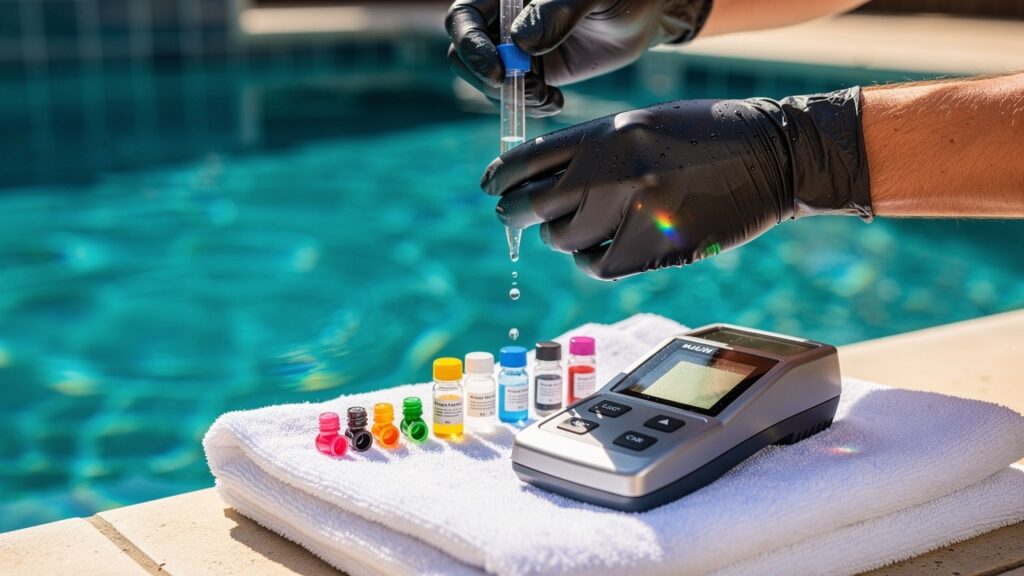
A professional maintenance company looks after the pool as one connected water and mechanical system.
Physical cleaning removes leaves, insects, dust, algae and mineral buildup. A normal service visit may involve skimming the surface, brushing the walls and steps, vacuuming the floor, clearing baskets and inspecting the waterline.
KCN states that its routine cleaning service uses brushing, surface skimming, filter backwashing, robot-assisted vacuuming and water testing. Its technicians also inspect pumps and baskets during visits.
Water testing is equally important because clear-looking water does not automatically mean the chemistry is suitable. KCN states that it tests and adjusts chlorine, pH and alkalinity during its maintenance visits.
A basic mechanical inspection should examine pumps, strainers, filters, valves and visible plumbing for weak flow, blockage, leakage, vibration, noise, pressure changes or deterioration.
The technician may not dismantle every component during a routine visit, but developing warning signs should be reported before they become major failures.
For shared facilities, maintenance may also involve written records, photographs, daily readings or coordination with property-management teams. The exact documentation required should be agreed in the maintenance contract rather than assumed.
What Is the Difference Between Pool Cleaning and Pool Maintenance?
Pool cleaning primarily addresses visible dirt. Pool maintenance protects the water quality and operating system that keep the pool usable.
Skimming and vacuuming may make a pool look tidy, but those tasks alone do not correct weak circulation, chemical imbalance, high filter pressure or a leaking pump seal.
Maintenance includes cleaning but adds testing, chemical adjustment, equipment observation and advice on developing faults.
This distinction matters when comparing companies. One quotation may cover basic cleaning only, while another includes standard chemicals, water readings, filter backwashing, equipment checks and a written report.
The quotations should be compared line by line. A package called “complete maintenance” is not necessarily complete unless the written scope explains what is actually included.
KCN combines cleaning with water balancing and quick system checks. Technical repairs, algae restoration and larger corrective work are treated as separate services because they require additional labour, parts or treatment.
KCN’s Clean–Test–Inspect–Report–Prevent Framework
This guide organises KCN’s published service process into five stages: Clean, Test, Inspect, Report and Prevent.
The Clean stage removes debris and buildup through skimming, brushing, vacuuming, basket clearing and filter backwashing where appropriate. The objective is to reduce the physical load placed on the water and filtration system.
The Test stage examines water conditions and makes normal adjustments. Water testing should be based on actual readings rather than chemical dosing by habit.
The Inspect stage checks visible circulation components for early signs of trouble. Weak flow, pressure changes, leakage, vibration and unusual noise should be noticed before equipment stops working completely.
The Report stage communicates what happened during the visit. The owner or property manager should know what was cleaned, which readings were taken, which treatments were applied and whether follow-up is recommended.
The Prevent stage uses regular service history to reduce recurring algae, premature equipment failure and emergency repair costs. The goal is not only to correct today’s water condition but to identify patterns before they become expensive.
How Often Should a Swimming Pool Be Maintained in Singapore?
Most private pools in Singapore benefit from professional attention at least once a week.
A weekly schedule helps control debris, water chemistry and equipment condition before changes become difficult to reverse. Pools exposed to surrounding trees, direct sun, heavy rain or regular family use may require closer attention.
KCN states that most landed-home pools require weekly cleaning. It also states that condominiums and shared facilities commonly require two or three visits each week. The correct frequency for any shared facility should still reflect its size, bather load, operating hours, filtration performance, management programme and water-test results.
A service provider should not follow a calendar blindly. Additional attention may be needed after severe weather, heavy use, contamination incidents, equipment problems or prolonged access restrictions.
Between professional visits, landed homeowners can remove large floating debris and observe changes in water clarity, water level, pressure and pump sound.
Chemical correction, pump disassembly, electrical work and leak tracing should be handled by suitably trained personnel.
How Does Maintenance Differ for Landed Homes and Shared Pools?
A landed-home pool generally serves one household and has lower bather traffic. Maintenance can usually be organised directly between the owner and the contractor.
A condominium or commercial pool may serve many users and involve an MCST, managing agent, facilities team, security personnel and external laboratories.
Shared facilities may require more frequent attendance, clearer access arrangements, formal service reporting and faster escalation when equipment or water quality becomes unsuitable.
Some aquatic facilities at non-residential premises are licensable under NEA requirements. The licensee is responsible for maintaining cleanliness, arranging required laboratory testing and submitting water-quality results.
NEA also requires aquatic facility licensees to conduct on-site testing of pH and residual disinfectant at least once daily. Those tests may be carried out by in-house staff, the maintenance contractor or an appropriately accredited laboratory, but the results must be recorded and retained for 12 months.
A maintenance contractor may assist with these activities, but appointing a contractor does not automatically transfer the licensee’s regulatory responsibility.
The service agreement should therefore state which tests the contractor performs, what records it supplies, which incidents it reports and what duties remain with the owner, MCST, managing agent or operator.
How Should You Compare Swimming Pool Maintenance Companies?

The comparison should begin with the type of property and pool the company regularly maintains.
A contractor experienced mainly with small private pools may not automatically be suitable for a large condominium with several water bodies, balancing tanks and formal reporting requirements.
Ask the company to explain how it schedules visits, assigns technicians, manages access and handles staff absences. Consistency matters because a service programme becomes less reliable when visits depend entirely on one individual.
Technical capability should also be examined. A provider should be able to recognise when a problem involves water balance, circulation, filtration, plumbing, surfaces or equipment.
A cleaning company that cannot investigate technical problems may need to refer every fault to another contractor. That is not automatically unacceptable, but the owner should know who will diagnose the fault and who will remain responsible for coordinating repairs.
KCN provides pump repair, filter servicing, plumbing and equipment work, green-pool recovery, retiling and fibreglass coating in addition to routine cleaning.
A suitable provider should also explain how it decides between repair and replacement. KCN states that it considers repair for problems involving parts such as seals, bearings and gaskets and recommends replacement when the unit is beyond economical repair.
The provider’s reporting process should be reviewed before the contract begins. Ask to see an anonymised sample report showing readings, completed tasks, observations and recommended action.
Communication is just as important as technical ability. The company should provide a reliable contact point and explain what happens when a scheduled visit is affected by weather, access or a public holiday.
How Should Credentials Be Checked?
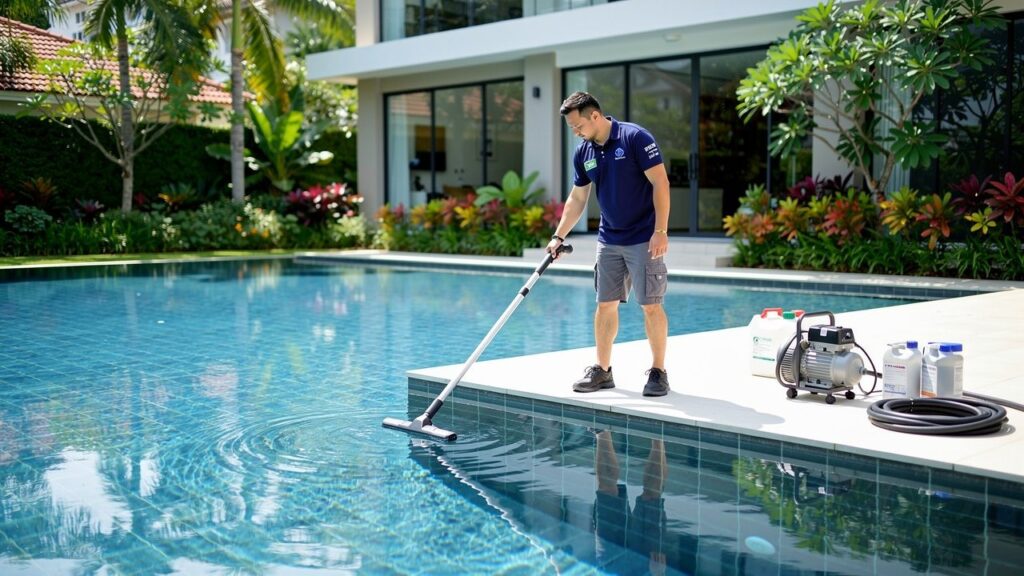
KCN’s website describes its cleaning specialists as “BizSafe Level 3 and BCA L1-trained.” Other KCN service pages refer to work following bizSAFE Level 3 and BCA L1 standards. These descriptions should not be treated as permanent proof of current registration without verification.
The official styling is bizSAFE. The Workplace Safety and Health Council provides a self-help service where customers can check a company’s current bizSAFE level, status and certificate expiry using its name or UEN.
BCA registration should also be verified using the current BCA directory. A registration grade and workhead indicate eligibility and tendering limits within the relevant registration system. They do not by themselves guarantee that every project will be completed without defects.
Credentials are useful indicators, but owners should also assess actual project experience, supervision, insurance, safety procedures, reporting and workmanship support.
What Should a Pool Maintenance Contract Include?
The contract should first define how often the contractor will attend.
It should explain whether visits occur on fixed days, how missed visits are replaced and what happens on public holidays or during periods when access is unavailable.
The routine task list should describe cleaning, water testing, chemical treatment, basket clearing, filter care and equipment observations in clear terms.
The contract should avoid broad phrases such as “general maintenance as needed” unless the meaning is defined elsewhere.
Chemical responsibilities should be stated precisely. The agreement should explain whether routine balancing chemicals are included, whether usage is capped and which treatments are charged separately.
Green-pool recovery, shock treatment, unusual contamination and large chemical corrections are commonly outside ordinary maintenance. KCN states that algae restoration is separate from regular cleaning because the chemicals and labour are different.
Repair approval should also be documented. The contractor should not carry out significant chargeable work without informing the authorised owner or manager unless a defined emergency arrangement applies.
The agreement should explain call-out fees, diagnostic charges, replacement-parts approval, manufacturer warranties and workmanship support.
Cancellation terms, notice periods, payment dates, late-payment conditions, account ownership and access arrangements should be easy to find.
What Should a Pool Service Report Contain?
A useful landed-home report should record the date, attendance, work completed, important water readings, chemicals added, equipment observations and any recommended follow-up.
For shared facilities, the report may need greater detail. It may include the technician’s name, visit time, readings from specified water bodies, abnormalities, corrective treatment, photographs and outstanding work.
The report should separate routine observations from urgent faults. A minor developing noise should not be presented in the same way as a pump failure or an unsafe water condition.
Owners should also know how long the contractor retains its records and whether reports remain accessible after the contract ends.
For licensable aquatic facilities, the maintenance report should not be confused with the facility’s complete regulatory record. The contract should state how contractor records support the licensee’s own compliance process.
What Should “Chemicals Included” Mean?
“Chemicals included” can mean different things in different quotations.
One provider may include normal quantities of chlorine and pH-adjustment chemicals used during standard weekly service. Another may charge for every chemical separately.
Even when routine chemicals are included, abnormal treatment may remain chargeable. A pool that has turned green, been contaminated or gone without circulation may need stronger treatment, repeated visits or filtration work.
The contract should explain whether there is a normal chemical allowance and which conditions create additional charges.
A low monthly price that excludes routine chemicals may eventually cost more than a higher package with a transparent allowance.
What Does Swimming Pool Maintenance Cost in Singapore?

KCN currently publishes a typical range of S$150 to S$350 per month for landed-home pool cleaning, depending on pool size. Condominium and commercial pools require customised quotations based on the number of pools, their dimensions and visit frequency.
The final cost may also reflect pool depth, surrounding trees, water condition, access, chemical usage, filtration type and reporting requirements.
A monthly maintenance fee normally does not include every future repair.
KCN publishes a landed-home pump-repair range of approximately S$120 to S$350, depending on parts and repair time. Full pump replacement is quoted according to the model and installation requirements.
KCN lists filter servicing or replacement for landed-home pools at approximately S$200 to S$600, depending on pool size, filter media and condition. Condominium and commercial work requires a customised quotation.
Green-pool restoration is also priced separately. KCN currently lists approximately S$150 to S$850 per session for landed-home pools, depending on the severity of the algae and water condition.
For surface work, KCN publishes approximately S$300 to S$800 for partial retiling or patch repairs and S$400 to S$900 for partial fibreglass coating. Full retiling and full-pool fibreglass coating require individual quotations.
These figures should not be added together to estimate a project without inspection. A visible symptom may have a different underlying cause, and the contractor may recommend only part of the available work.
KCN’s website currently advertises a S$50 pool inspection. Customers should confirm what the inspection includes, whether the fee is credited towards approved work and which properties or services are eligible.
What Emergency Support Should a Maintenance Company Provide?
A maintenance contract should distinguish normal servicing from urgent attendance.
An emergency may involve pump failure, sudden water loss, contamination, electrical issues, unsafe water conditions or a shared pool that must be closed.
The provider should explain its normal operating hours, after-hours availability, call-out charges and likely response time.
KCN’s website currently lists operating hours from 9:00 a.m. to 6:00 p.m. on weekdays and 8:00 a.m. to 4:00 p.m. on weekends. These published hours should not be interpreted as a guaranteed emergency-response commitment unless the quotation or contract states one.
For a condominium or commercial facility, response expectations should be written into the contract. Verbal statements such as “we will come quickly” are difficult to enforce when a serious fault occurs.
Which Warning Signs Suggest a Poor Maintenance Provider?
Repeated cloudiness without a clear explanation may indicate weak testing, poor circulation or incomplete maintenance.
A provider should not repeatedly add chemicals without examining why the water condition keeps returning.
Missing service records are another warning sign. If the company cannot show when it attended, what it tested or what it added, the owner has little evidence that the contract is being fulfilled.
Constantly recommending replacement without diagnosis should also raise concerns. Pumps, filters and valves contain components that may sometimes be repaired.
The contractor should identify the faulty part and explain why repair or replacement is the better option.
Unclear quotations create similar risks. Watch for missing visit frequency, undefined chemical charges, broad exclusions or authority to perform repairs without approval.
Poor communication can allow manageable issues to become urgent. Repeated missed visits, unanswered messages and unexplained technician changes suggest that the provider may lack a dependable operating process.
When Does a Pool Need More Than Routine Maintenance?
Routine servicing is not sufficient when a pool has persistent algae, major water loss, pump failure, damaged filtration, cracked surfaces, loose tiles or widespread staining.
Green water often requires separate restoration because the treatment may involve diagnosis, filter and pump cleaning, repeated brushing, vacuuming, shock treatment and water rebalancing. KCN states that its green-pool service addresses water chemistry, filtration and circulation rather than treating only the visible algae.
Weak flow, unusual pump noise, visible leakage or frequent tripping should be investigated before the pump fails completely. KCN’s pump service includes inspection of the housing, seals, impeller, pressure, flow and relevant components.
A filter may require deeper servicing when pressure remains abnormal, flow is weak or debris returns to the pool. KCN’s filter service includes housing inspection, cleaning, media replacement where required, pressure checks and final testing.
Unusual water loss may indicate a leak in a valve, joint, fitting, pipe or pool surface. Adding water repeatedly without diagnosing the cause can waste water and allow damage to continue.
Loose or damaged tiles may require patching or wider retiling after the substrate and waterproofing condition are examined. Fibreglass coating may be suitable for certain worn or damaged surfaces, but it should not be assumed to solve every structural or plumbing leak.
What Should You Check Before Changing Maintenance Companies?
Before the new contractor begins, gather previous service reports, equipment details, repair records and any recent water-test results.
The incoming company should inspect the pool rather than assume the existing condition is normal.
Ask whether the first visit is charged at the ordinary maintenance rate or whether additional treatment may be required.
KCN states that an initial visit may follow standard rates when a pool is already in good condition, while neglected pools may require extra attention.
Confirm who owns keys, access cards, chemical stock, service records and any remote equipment credentials.
The outgoing provider should not retain exclusive access to information required for the pool’s continued operation.
The new contract should begin with a written baseline condition so existing defects are not confused with problems that developed after the handover.
What Proof Should a Maintenance Company Provide?
A maintenance company should be able to show real work rather than relying only on general claims.
Useful evidence can include before-and-after photographs, anonymised service reports, equipment-repair examples and references from properties with similar requirements.
KCN’s service pages state that its website photographs include actual before-and-after results from KCN projects. Property owners should still ask which type of project is shown and what work was completed.
A detailed case study is more useful than a photograph alone. It should explain the original symptom, diagnosis, work performed, duration and result.
Reviews can support the assessment, but they should be considered together with service records, credentials and the clarity of the quotation.
Why Consider KCN Pool Services for Ongoing Pool Care?
KCN combines routine cleaning with water balancing and basic checks of pumps, strainers and filters. It also uses robotic vacuum support as part of its cleaning process.
When technical problems appear, KCN offers pump repair and replacement, filter work, plumbing repairs and wider equipment services.
For neglected or ageing pools, its published service range includes green-pool recovery, retiling and fibreglass coating.
This broader scope may be useful to owners who prefer one company to understand the pool’s maintenance history and coordinate different stages of care.
Routine maintenance still does not include every repair or restoration project. Each additional service should be diagnosed and quoted separately.
KCN states that if a customer is dissatisfied with the cleaning outcome, the company will return and re-clean at no extra cost. Its repair and restoration pages contain separate workmanship-related return-and-fix statements. The exact terms, limits and exclusions should be confirmed in the written quotation.
KCN may therefore be one Singapore provider homeowners and property managers can consider, but the final choice should depend on site requirements, service reports, technical capability, current credentials, pricing and contract terms.
Frequently Asked Questions
How often should a swimming pool be serviced in Singapore?
Most landed-home pools benefit from weekly professional servicing. Shared pools may require more frequent attention depending on bather load, operating hours, water conditions and management requirements. KCN states that it commonly recommends weekly visits for landed pools and two or three visits per week for shared facilities.
What should be included in a swimming pool maintenance service?
A complete routine service should include debris removal, brushing, vacuuming, basket clearing, water testing, normal chemical adjustment and basic observation of pumps, filters, strainers and visible plumbing. The exact scope and chemical inclusions should be stated in the contract.
Are chemicals included in the monthly maintenance fee?
This depends on the provider and package. Some contracts include normal quantities of routine balancing chemicals, while abnormal treatment, green-pool recovery or large corrections are charged separately. The quotation should define the inclusion rather than simply saying “chemicals included.”
Is green-pool treatment part of normal maintenance?
Usually not. KCN treats green-pool recovery as a separate service because it may require stronger chemicals, extended filtration, repeated cleaning and additional labour.
Does a pool maintenance company handle NEA testing?
A contractor may conduct daily on-site tests or assist with records when this is included in the contract. For a licensable aquatic facility, however, the licensee remains responsible for meeting NEA requirements, arranging the relevant testing and retaining the required records.
Do I need to be home during a landed-pool service?
Not necessarily. KCN states that it can clean and inspect a pool without the owner being present once suitable access has been arranged.
How can I tell whether my pool pump needs repair?
Warning signs can include weak circulation, bubbling, new rattling or humming, vibration, visible leaks, repeated tripping or a pump that stops unexpectedly. The complete circulation system should be inspected before a repair or replacement decision is made.
How much does pool maintenance cost in Singapore?
KCN currently publishes a landed-home range of approximately S$150 to S$350 per month, depending on pool size. Condominium and commercial facilities require customised quotations.
What should I request before signing a contract?
Request the visit frequency, complete task scope, chemical inclusions, report format, repair approval process, emergency arrangements, response expectations, warranties, exclusions, payment terms and cancellation conditions.
How long should a pool maintenance contract run?
The appropriate term depends on the property and commercial arrangement. The contract should provide enough time to establish consistent maintenance while including a reasonable termination process if service standards are not met.
Conclusion
Choosing between swimming pool maintenance companies in Singapore is ultimately a decision about reliability, technical care and transparency.
The right company should do more than make the pool look clean on the day of the visit. It should manage water balance, observe circulation and filtration, identify developing faults and maintain records that help the owner understand what is happening.
Monthly fees should be compared only after every contractor has provided a comparable written scope.
For shared facilities, the contract should also clarify how the contractor supports the licensee’s testing, reporting and corrective-action responsibilities.
KCN Pool Services provides scheduled cleaning, water balancing, equipment observations, pump and filter services, plumbing repairs, green-pool restoration, retiling and fibreglass coating for homes, condominiums and commercial properties in Singapore.
Its Clean–Test–Inspect–Report–Prevent process provides a practical way to evaluate whether routine pool care is protecting both the water and the operating system.
For owners who are uncertain about the condition of their pool, KCN currently advertises a S$50 inspection and written quotation as a starting point. The exact inspection scope and service terms should be confirmed before booking.

Leave A Comment