


CALL US NOW!
+65 9009 7510
CALL US NOW!
+65 9009 7510
Swimming Pool Specialists Singapore: Services, Costs and Hiring Guide
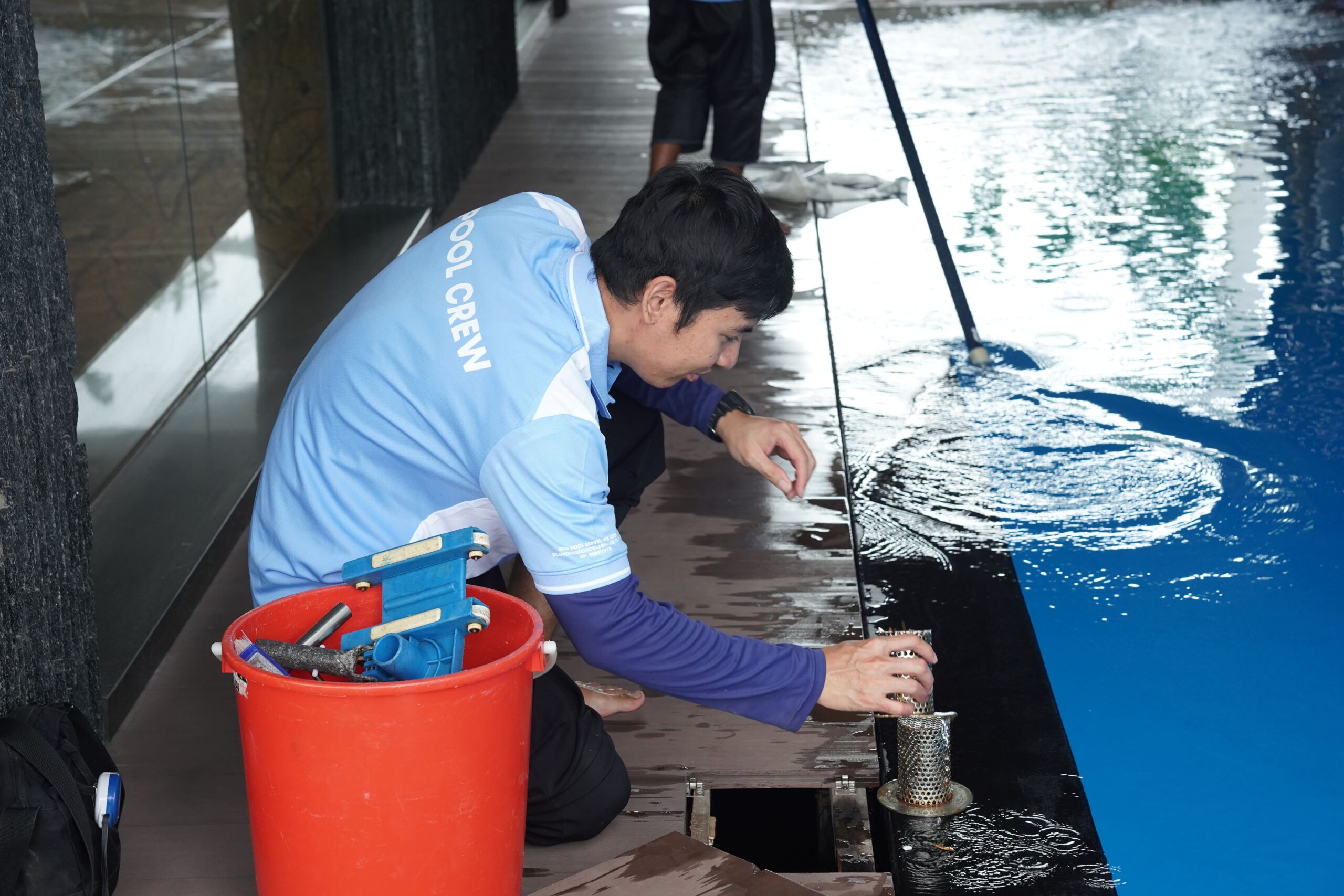
Choosing a swimming pool specialist in Singapore requires more than finding someone who can remove leaves and make the water look clear. The provider should be able to assess the pool as one connected system involving water chemistry, circulation, filtration, pumps, plumbing, fittings and surfaces.
The right specialist depends on what the pool actually needs. Routine cleaning may be enough for a well-maintained landed-home pool, while recurring algae, weak circulation, falling water levels, noisy equipment, damaged tiles or rough coatings require more focused diagnosis and repair.
KCN Pool Services is primarily positioned as a swimming pool cleaning, maintenance, repair and restoration specialist. Its published service range includes regular pool care, pump repair and replacement, filter servicing, plumbing and equipment work, green-pool recovery, retiling and fibreglass coating. KCN’s own installation guide distinguishes this work from the role of a builder constructing a new pool shell.
For landed-home pools, KCN currently publishes a regular cleaning range of approximately S$150 to S$350 per month. Other common KCN service ranges include S$120 to S$350 for standard pump repair, S$200 to S$600 for filter work and S$150 to S$850 per green-pool restoration session. These are KCN’s published planning ranges rather than guaranteed Singapore-wide market averages, and the final price depends on the pool’s condition, access, parts and required work.
This guide explains what swimming pool specialists do, how they differ from cleaners and builders, what KCN’s services may cost, how shared-pool responsibilities differ from private residential maintenance and what owners should check before approving a contract or repair.
Key Takeaways
A swimming pool specialist should look beyond the visible symptom. Cloudy water may involve chemistry, filtration or circulation. Weak flow may originate in the pump, filter, valve, blockage or plumbing. Recurrent algae may return when treatment clears the water without correcting the system problem that caused it.
A pool cleaner mainly handles physical cleaning and routine water care. A maintenance company adds scheduled testing, chemical adjustment, equipment observations and preventive reporting. A repair contractor addresses a specific pump, filter, plumbing or surface fault. A pool builder coordinates the design and construction of a new pool. A broader pool specialist may cover several of these areas, but owners should verify the provider’s actual capabilities instead of relying on the word “specialist.”
KCN’s service pages describe regular cleaning that includes brushing, skimming, filter backwashing, water testing and balancing, robot-assisted vacuuming, and quick checks of pumps, strainers and filters. Technical repairs, algae recovery and surface restoration are separate services because they require additional diagnosis, materials, labour or equipment.
Price should be compared together with scope. A lower maintenance fee may exclude routine chemicals, reporting, filter care or additional treatment. A low repair quotation may exclude replacement parts, pressure testing, electrical work, excavation or reinstatement.
For licensable aquatic facilities at non-residential premises, the facility licensee remains responsible for meeting applicable NEA requirements. A maintenance specialist may support testing, treatment and records, but appointing a contractor does not automatically transfer the licensee’s regulatory responsibilities.
How This Guide Was Developed
This guide combines KCN Pool Services’ current published service descriptions and indicative pricing with official information from Singapore’s National Environment Agency, Workplace Safety and Health Council and Building and Construction Authority.
Each price is identified as a KCN planning range rather than an independent industry average. The final cost may change after inspection because two pools showing the same visible symptom can require very different work.
The regulatory sections distinguish ordinary private landed-home maintenance from the responsibilities applying to licensable aquatic facilities at non-residential premises.
KCN has a commercial interest in providing the services discussed. Owners, MCSTs, managing agents and commercial property teams should compare current credentials, scope, insurance, pricing, reporting and project suitability before selecting any provider.
What Is a Swimming Pool Specialist?
A swimming pool specialist is a provider with practical knowledge of the water and mechanical systems that allow a pool to operate.
This normally includes water treatment, cleaning, circulation, filtration, pumps, valves, fittings, visible plumbing and surface condition. Some specialists also provide construction, waterproofing or structural work, while others focus on maintenance and repair.
The term itself is not a protected guarantee of capability. One company may use it while providing only routine cleaning. Another may diagnose pumps and filters but subcontract surface restoration. A third may build new pools but not provide reliable long-term maintenance.
Owners should therefore ask what the company completes using its own team, what it coordinates through subcontractors and which work it does not accept.
KCN’s published offering centres on maintenance, equipment diagnosis, repair and restoration. For new-pool construction, homeowners should appoint an appropriate builder and professional project team, then engage KCN separately for post-handover maintenance where suitable.
What Is the Difference Between a Pool Specialist, Cleaner, Maintenance Company, Contractor and Builder?
A swimming pool cleaner normally focuses on visible cleanliness. The work may include skimming, brushing, vacuuming, clearing baskets and basic water treatment.
A pool maintenance company performs those cleaning tasks on a planned schedule and adds water testing, chemical balancing, filter care, system observations and preventive reporting.
A repair contractor is appointed when a specific fault requires diagnosis or corrective work. This may involve pumps, filters, valves, plumbing, lights, controls, tiles, grout or coatings.
A swimming pool builder coordinates a new construction or substantial renovation project. The scope may involve design, professional submissions, excavation, structure, waterproofing, plumbing, electrical installation, finishes, testing and handover.
A swimming pool specialist is the broader description. The company may provide one, several or all of these capabilities.
This distinction matters because the cheapest cleaner may not be able to diagnose a recurring circulation problem, while a pool builder may not provide ongoing water care after handover. The owner should select the provider based on the actual scope rather than the broad job title.
What Does a Swimming Pool Specialist Do During Routine Maintenance?
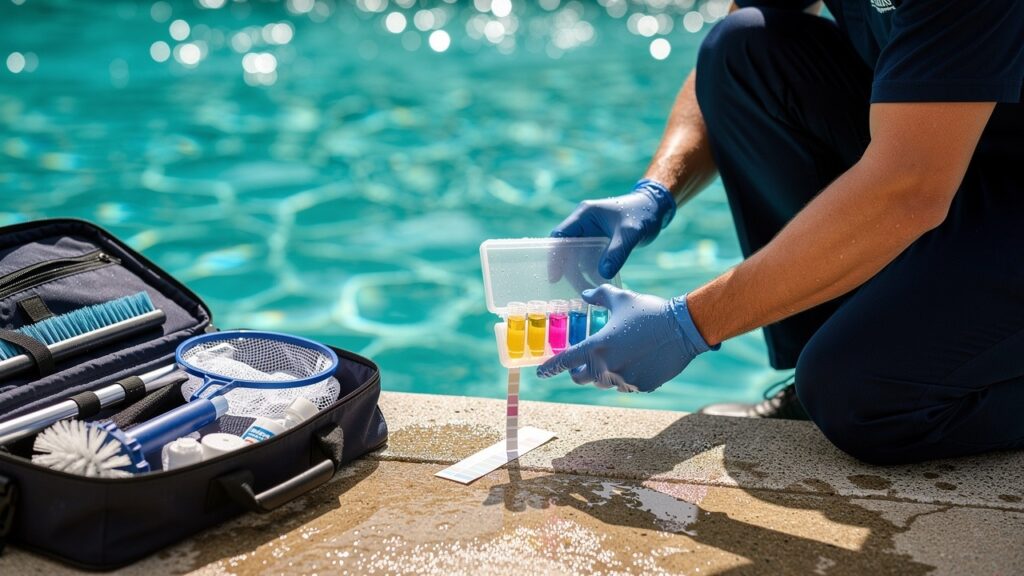
Routine maintenance begins with removing the physical material that enters or develops inside the pool.
Technicians may skim the surface, brush walls and steps, scrub the tile line, vacuum the floor, clear baskets and backwash or rinse the filtration system where appropriate.
KCN states that its regular cleaning service combines manual brushing and skimming with robot-assisted floor cleaning. It also checks and adjusts chlorine, pH and alkalinity and performs quick observations of the pump, strainers and filters.
These quick system checks are not the same as dismantling or repairing equipment. Their purpose is to notice warning signs such as weak flow, unusual pressure, leakage, noise, vibration or visible deterioration.
A useful maintenance visit should leave the owner with a clearer understanding of the pool’s condition, not merely a cleaner-looking pool.
KCN’s Water–Flow–Equipment–Surface Diagnostic Method
This guide organises pool diagnosis around four connected areas: Water, Flow, Equipment and Surface.
The Water stage examines clarity, colour, chemical readings, algae, staining, contamination and how quickly the condition changes after treatment.
The Flow stage assesses whether water is moving effectively through the pool. Weak returns, air bubbles, uneven circulation, abnormal filter pressure and stagnant areas may indicate blockages, valve problems, air entry or hydraulic limitations.
The Equipment stage examines pumps, filters, strainers, valves, controls, fittings and visible plumbing. The technician should consider whether the equipment itself has failed or is reacting to a fault elsewhere in the system.
The Surface stage reviews tiles, grout, coatings, joints, fittings, cracks and areas where water may escape or deterioration may continue behind the visible finish.
A responsible recommendation should consider all four areas before the company decides that the solution is more chemicals, equipment replacement, plumbing work or resurfacing.
What Swimming Pool Services Does KCN Provide?
KCN’s current service range covers routine maintenance, pump work, filter servicing, plumbing repairs, green-pool recovery and surface restoration. Each service addresses a different part of the pool system and should be quoted according to the diagnosed condition.
Swimming Pool Cleaning and Water Care
Regular cleaning prevents leaves, dirt, algae and mineral deposits from becoming established on the pool floor, walls, steps and waterline.
Water care is equally important because appearance alone does not prove that the chemistry is balanced. A clear pool can still have unsuitable chlorine or pH readings.
KCN’s cleaning service includes brushing, tile scrubbing, surface skimming, filter backwashing and rinsing, water testing and balancing, and pump and basket observations. The company also states that robotic vacuum equipment supports deeper floor cleaning.
KCN says most landed-home pools need weekly cleaning, while condominiums and shared facilities commonly require two or three visits per week. The correct frequency should still reflect pool size, bather load, weather exposure, operating hours, surrounding trees and water-test results rather than being treated as a universal legal rule.
Routine cleaning does not include every form of algae treatment or equipment repair. KCN states that green-pool recovery is separate because it involves different chemicals, labour and filtration requirements.
Pump Repair and Replacement
The pump moves water through the filtration and treatment system. When it loses performance, the effect can appear throughout the pool.
Warning signs include weak circulation, unusual rattling or humming, vibration, leakage, frequent tripping or inconsistent operation.
KCN’s pump service includes checks of the housing, seals and impeller, leak and corrosion inspection, pressure and flow testing, component replacement and final system testing.
The diagnosis should also consider whether the pump is reacting to another problem. A blockage, clogged filter, closed valve, low water level or air entering the suction line may create symptoms that resemble pump failure.
KCN states that parts such as bearings and gaskets may be replaced when repair remains practical. It says complete replacement is recommended when the existing unit is no longer economical or reliable to repair.
Minor pump repairs may sometimes be completed during the first visit. More complex work requiring parts may take approximately one to three days, depending on availability.
Filter Servicing and Replacement
The filter removes smaller particles that brushing, skimming and vacuuming cannot fully control.
A clogged or worn filter can reduce flow, return fine material to the water and increase the demand placed on the pump.
KCN’s filter service includes inspection and cleaning, media replacement where required, housing and valve cleaning, pressure checks, reassembly and final testing.
Filter and pump performance should be assessed together. A struggling pump can reduce filtration flow, while a blocked filter can make a healthy pump work harder.
The technician should explain whether the filter needs ordinary backwashing, deeper cleaning, media replacement, valve repair, housing work or complete replacement.
Plumbing and Equipment Repair
Pool plumbing faults can begin with subtle changes.
The water level may drop faster than expected, return flow may weaken, air may appear in the system or a valve or fitting may begin leaking.
KCN’s plumbing service includes leak detection, pipe and valve replacement, joint and seal inspection, pressure testing and system recalibration.
A minor leak at an accessible fitting is very different from a concealed pipe problem beneath a deck or beside the pool shell. The specialist should explain which tests will be performed before recommending that finished surfaces are opened.
KCN states that it checks pumps, plumbing lines, joints, valves and fittings so the source of water loss or circulation problems can be identified more accurately.
Green Pool Restoration
A green pool generally needs more than a standard maintenance visit.
Algae may exist throughout the water, on surfaces and inside the filtration system. Treating only the visible water can produce a short-lived improvement.
KCN’s green-pool restoration process includes water testing, filter and pump cleaning, brushing, vacuuming, shock treatment, algae removal, clarification and water balancing.
The cause may involve missed servicing, inadequate sanitiser, unstable chemistry, poor circulation or a filtration problem. The specialist should explain why the condition developed and what follow-up will reduce the risk of recurrence.
KCN says many pools can be cleared within approximately 24 to 72 hours, depending on severity and the condition of the filtration system. This should be treated as an indicative service estimate rather than a guarantee for every pool.
Retiling and Surface Repair
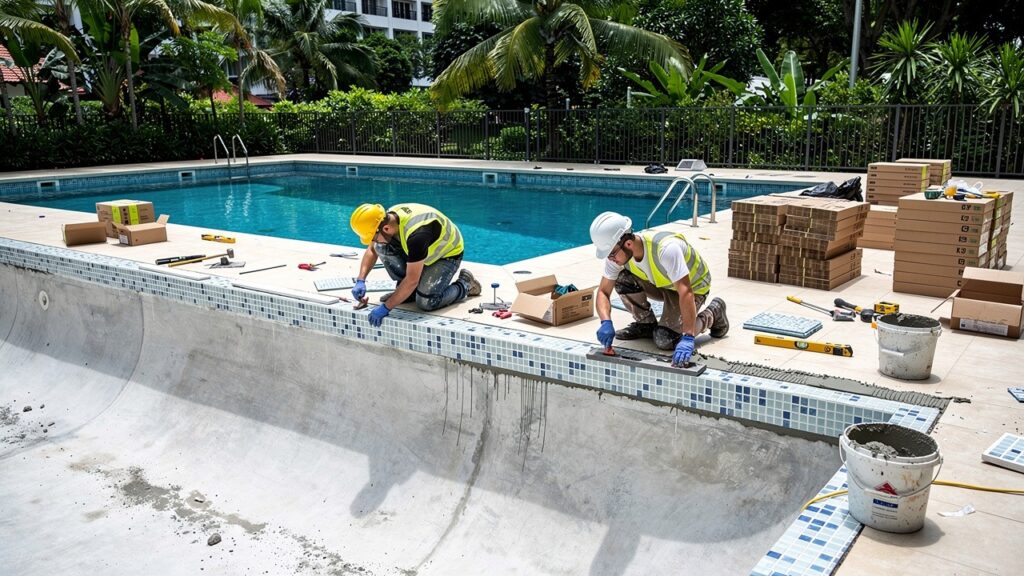
Loose, cracked or chipped tiles can affect comfort, appearance and safety. Damaged areas may also allow moisture to move behind the visible finish.
KCN’s retiling service includes removing damaged materials, preparing the surface, installing and aligning replacement tiles, grouting, sealing, edge and step finishing, and final inspection.
Before retiling, the specialist should check whether the problem is limited to a small area or reflects wider substrate, waterproofing or movement issues.
A patch repair may be appropriate when the surrounding tilework remains sound. Widespread debonding, worn grout or extensive damage may justify broader retiling.
Fibreglass Coating
Fibreglass coating can be considered when a pool surface becomes rough, faded, cracked or difficult to maintain.
The process may involve draining the pool, preparing and cleaning the surface, repairing cracks or holes, applying resin layers, adding a protective topcoat and allowing the material to cure before refilling.
KCN states that fibreglass can often be applied over concrete or older finishes after proper preparation, although a site inspection is required to confirm suitability.
Fibreglass should not be treated as a universal solution for every water-loss problem. An active structural crack or leaking pipe may require separate repair before a coating is applied.
How Much Do Swimming Pool Specialists Cost in Singapore?
Swimming pool specialist pricing depends on the service, pool dimensions, condition, access, materials and amount of diagnosis required.
The following figures are KCN’s current published ranges for landed-home pools. They should be treated as planning references rather than fixed Singapore market rates.
Swimming Pool Cleaning Cost
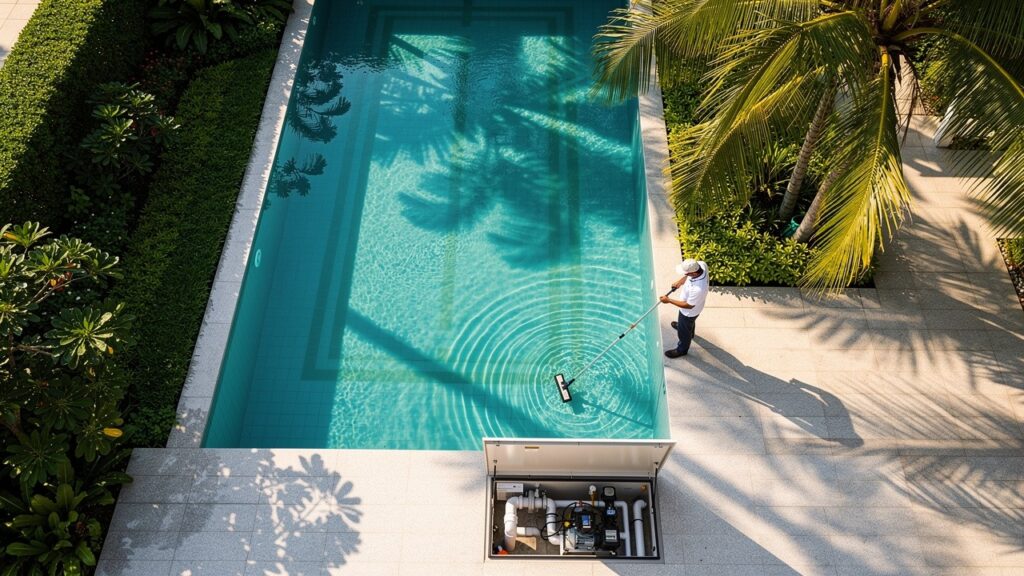
KCN lists monthly cleaning for landed homes at approximately S$150 to S$350, depending on pool size. Condominium and commercial facilities receive customised quotations based on pool numbers, dimensions and visit frequency.
The quotation should confirm whether ordinary balancing chemicals, filter backwashing, system observations, reporting and extra visits are included.
Pump Repair Cost
KCN lists standard landed-home pump repair at approximately S$120 to S$350, depending on parts and repair time. Pump replacement requires a customised quotation based on the model and installation conditions.
The quotation should identify the suspected fault, parts required, labour, electrical considerations and whether the repair is expected to provide a dependable result.
Filter Servicing Cost
KCN lists filter servicing or replacement for landed-home pools at approximately S$200 to S$600. The price depends on pool size, filter type, media and condition. Condominium and commercial facilities require individual quotations.
Plumbing Repair Cost
KCN lists minor landed-home repairs such as small leaks, loose fittings or simple sealing at approximately S$80 to S$250.
Moderate work involving pipes, valves or joints is listed at approximately S$150 to S$400. Severe leaks, blockages and multiple component replacements require a customised quotation.
Green Pool Restoration Cost
KCN lists landed-home green-pool restoration from approximately S$150 to S$850 per session, depending on algae severity, how long the water has been stagnant and whether the filtration system requires additional work.
Retiling Cost
KCN lists partial retiling or patch repairs at approximately S$300 to S$800 for landed-home pools. Full-pool retiling is quoted according to pool dimensions, material selection, removal difficulty and any waterproofing repairs required.
Fibreglass Coating Cost
KCN lists partial fibreglass coating for small repair areas or isolated cracks at approximately S$400 to S$900. A complete coating project requires a customised quotation based on surface condition, preparation, coating layers and curing requirements.
What Should Be Included in a Specialist’s Quotation?
The quotation should begin with the diagnosed or suspected problem.
For repair work, it should state which equipment, pipework or surface will be inspected and what testing is included.
The scope should identify labour, replacement components, materials, access requirements and any work that will be subcontracted.
Exclusions should be visible. The owner should know whether draining, water replacement, electrical work, excavation, deck removal, reinstatement or follow-up treatment is outside the quoted amount.
The quotation should also explain possible variations. A contractor may be unable to see the full condition of concealed pipes or the surface beneath loose tiles until work begins, but the process for approving additional costs should be agreed in advance.
Warranty wording should distinguish manufacturer coverage from workmanship support. A broad phrase such as “guaranteed repair” is not sufficient unless the period and exclusions are stated.
How Do You Choose the Right Swimming Pool Specialist?
The best swimming pool specialist for a Singapore property is one that has relevant experience, diagnoses the system before recommending expensive work, provides an itemised quotation, explains repair-versus-replacement reasoning and offers clear aftercare.
Begin by checking whether the company regularly works with your property type.
A landed-home pool has different access and usage conditions from a condominium or commercial facility. Shared pools may involve larger plant rooms, formal reporting, managing-agent coordination and more demanding response arrangements.
Ask the provider to explain its diagnostic process. A strong answer should identify what it will test and how the result changes the recommendation.
The specialist should be able to explain why a pump should be repaired, why a filter needs new media, why a green pool requires separate treatment or why damaged tiles need wider surface work.
The company should also explain which services are carried out by its own technicians and which require another contractor.
Communication matters as much as technical knowledge. Owners should know who provides updates, how urgent issues are escalated and whether additional work can proceed without written approval.
How Should KCN’s Credentials Be Described?
KCN’s own cleaning page describes its team as “BizSafe Level 3 and BCA L1-trained specialists.” Its installation guide describes KCN as registered under BCA’s ME11 Mechanical Engineering workhead at L1.
The official programme styling is bizSAFE. The Workplace Safety and Health Council provides a self-help service where customers can check a company’s current bizSAFE level, status and certificate expiry using its registered name or UEN.
BCA also provides an official directory for registered contractors and licensed builders. Registration details should be checked there before work is awarded.
Credentials are useful indicators of company status and safety processes, but they do not replace a detailed scope, relevant experience, insurance, capable supervision or clear workmanship terms.
What Should Be Included in a Pool Maintenance Agreement?
The agreement should state the visit frequency and describe what happens during each routine visit.
It should explain whether skimming, brushing, vacuuming, basket clearing, filter backwashing, water testing and chemical adjustment are included.
The contract should define what “chemicals included” means. It may cover ordinary quantities used for routine balancing without including algae recovery, shock treatment, contamination or large corrective doses.
Equipment checks should be distinguished from repairs. A technician may inspect visible pump, filter and plumbing conditions during maintenance, but dismantling or replacing parts normally requires a separate quotation.
The contract should explain access, missed visits, public holidays, bad weather and circumstances requiring an additional visit.
Reporting expectations should also be stated. A service record may include attendance, completed tasks, water readings, chemicals added, visible faults and follow-up recommendations.
The owner should know how chargeable repairs are approved, whether diagnostic or call-out fees apply and how the agreement may be cancelled.
How Do Shared-Pool Responsibilities Differ From Landed-Home Maintenance?
Private landed-home pools and licensable aquatic facilities at non-residential premises do not have identical regulatory responsibilities.
NEA regulates licensable recirculating aquatic facilities and publishes requirements covering licensing, water-quality testing, result submissions and facility cleanliness. Its aquatic-facility information also includes daily on-site testing requirements for pH and residual disinfectant.
The facility licensee remains responsible for compliance. A pool specialist may conduct agreed tests, adjust chemicals or supply service records, but the contract should clearly explain which tasks the company performs and which duties remain with the licensee, MCST, managing agent or operator.
The maintenance company’s ordinary service record should not automatically be treated as the facility’s complete regulatory documentation.
Shared-pool contracts should therefore define the testing frequency, reporting format, escalation process and responsibility for arranging any accredited laboratory work required.
What Evidence Should a Pool Specialist Provide?
A credible specialist should be able to show completed work rather than rely only on general claims.
Useful proof may include before-and-after photographs, anonymised service reports, examples of pump or filter repairs and references from similar property types.
The evidence should explain what problem was present and what work produced the result. A clean photograph alone does not show whether the contractor corrected the underlying circulation or water-quality issue.
KCN states that several of its service pages show actual before-and-after results from KCN projects. Owners should still ask what service was performed and whether the example is comparable to their own pool.
A detailed case study should ideally include the starting condition, diagnosis, work completed, duration, parts or treatments used and the final result.
What Warning Signs Mean You Should Call a Specialist?
Cloudy water that returns after ordinary cleaning should be investigated. The cause may involve chemical balance, fine suspended material, weak circulation or ineffective filtration.
Green, yellow or brown water may indicate algae, staining, contamination or another water-quality problem. Delaying treatment can increase the work needed to recover the pool.
A water level that falls faster than expected deserves attention, especially when combined with wet areas, air bubbles, loose fittings or frequent refilling.
New pump noises, vibration, overheating, tripping or weak return flow are signs that the circulation system needs inspection.
Unusual filter pressure, dirt returning through the pool inlets or persistent dull water may indicate filter or valve problems.
Loose tiles, sharp edges, failing grout, rough coatings, cracks or expanding stains should also be assessed before deterioration spreads.
How Does Singapore’s Climate Affect Swimming Pool Care?
Singapore pools operate throughout the year and are regularly exposed to heat, sunlight, heavy rain and organic debris.
Rain can dilute the existing water chemistry and introduce dirt, leaves and contaminants. Water should be tested after major weather changes rather than treated using an automatic dose with no measurement.
Warm, sunny conditions can support faster algae growth when circulation or sanitiser levels fall.
Properties surrounded by trees may place additional demand on skimmers, baskets and filters because of leaves, seeds, pollen and insects.
Maintenance frequency should therefore respond to the pool’s actual exposure and usage. Two pools with similar dimensions may require different service programmes because their surroundings and operating conditions are different.
Why Consider KCN Pool Services?
KCN may be suitable for owners who want one company to support routine water care, equipment diagnosis, plumbing repairs and surface restoration.
Its cleaning service combines physical cleaning, robot-assisted vacuuming, water balancing and basic system checks. Its wider service range covers pumps, filters, plumbing, green-pool restoration, retiling and fibreglass coating.
This can be useful when a visible symptom may involve more than one part of the system. The same team can review the pool’s water behaviour, maintenance history, circulation equipment and previous repairs.
Routine maintenance does not include every corrective service. Technical repairs, algae recovery and surface work should still be diagnosed, approved and quoted separately.
KCN currently advertises a S$50 pool inspection on its service pages. Customers should confirm what the inspection covers, whether the fee is credited towards approved work and which properties or services qualify.
KCN’s cleaning page also states that it will return and re-clean at no extra cost when the cleaning outcome is unsatisfactory. Its repair and restoration pages contain separate workmanship-related return-and-fix statements. The exact terms and exclusions should be confirmed in the written quotation.
Frequently Asked Questions
What does a swimming pool specialist do?
A swimming pool specialist maintains, diagnoses, repairs or restores the systems that keep a pool operational. Depending on the provider, this may include cleaning, water testing, chemical balancing, pumps, filters, plumbing, tiles and surface coatings.
Is a swimming pool specialist the same as a pool builder?
Not necessarily. A builder coordinates new-pool construction, while a maintenance or repair specialist looks after the operating pool and its equipment. KCN is primarily positioned as a maintenance, repair and restoration provider rather than the contractor constructing the new shell.
How often should a swimming pool be serviced in Singapore?
KCN states that most landed-home pools need weekly cleaning, while shared facilities commonly require more frequent visits. The correct frequency depends on usage, water volume, surrounding debris, exposure and test results.
How much does a swimming pool specialist cost?
KCN’s published landed-home ranges include approximately S$150 to S$350 per month for cleaning, S$120 to S$350 for standard pump repair, S$200 to S$600 for filter servicing and S$150 to S$850 per green-pool restoration session. Other repair and restoration work requires separate assessment.
Are routine chemicals included in maintenance?
This depends on the provider and contract. The agreement should explain whether ordinary balancing chemicals are included and whether green-pool recovery, shock treatment or unusual chemical use is charged separately.
Is green-pool restoration part of regular cleaning?
KCN treats it as a separate service because it can require stronger chemicals, deep cleaning, extended filtration and additional visits.
Can a green pool be restored without draining it?
Many green pools can be treated through testing, shock treatment, brushing, vacuuming, filtration cleaning and chemical balancing. Whether draining is necessary depends on contamination, severity, surfaces and system condition.
When should a pump be repaired instead of replaced?
Repair may be suitable when the problem involves serviceable components such as seals, bearings, gaskets or limited electrical parts. Replacement may be more practical when the motor or housing is badly damaged, repeated repairs have failed or parts are unavailable.
How long does pump repair take?
KCN states that minor repairs may be completed during the same visit. More complex repairs requiring parts commonly take approximately one to three days, depending on availability.
Does a pool need to be drained for retiling or coating?
Retiling and fibreglass coating commonly require the affected area or pool to be drained so the surface can be prepared, repaired and finished. The exact process depends on the scope and pool condition.
How can I verify a pool company’s bizSAFE or BCA information?
The company’s bizSAFE status can be checked through the Workplace Safety and Health Council’s bizSAFE self-help service. BCA registration information can be checked through the official BCA Directory.
Does a maintenance company take over NEA responsibility for a condominium pool?
No. A maintenance company may support testing, treatment and reporting, but the aquatic-facility licensee remains responsible for meeting the applicable NEA requirements.
What should I request before approving repair work?
Request the diagnosis, work scope, parts, labour, exclusions, access requirements, expected downtime, warranty terms and the process for approving additional work.
Conclusion
The right swimming pool specialist should help owners understand what is happening inside the pool system rather than merely treating visible symptoms.
Good service considers water, circulation, equipment and surfaces together. It distinguishes routine maintenance from specialised restoration and explains when a component should be repaired rather than replaced.
For Singapore landed homes, condominiums and commercial properties, KCN Pool Services offers regular cleaning, water balancing, pump and filter services, plumbing repairs, green-pool recovery, retiling and fibreglass coating.
Its Water–Flow–Equipment–Surface approach provides a practical way to assess whether a problem is caused by chemistry, circulation, mechanical equipment, plumbing or pool finishes.
When comparing providers, focus on the quality of the diagnosis, the completeness of the written scope, current credentials, relevant experience and the reasoning behind each recommendation.
A pool that receives consistent care and timely repairs is easier to operate, more comfortable to use and less likely to develop expensive failures without warning.

Leave A Comment